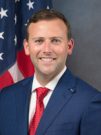
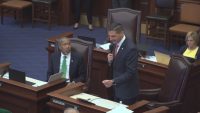
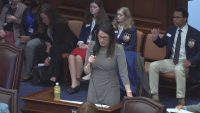
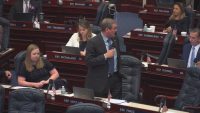
Following the conclusion of the 2022 legislative session on March 11, 2022 Mike Vasilinda stepped down from daily coverage of the Capitol to focus on other projects and managing his full service production company, Mike Vasilinda Productions. He can be reached at 850.445.5111 or mikev@mvptv.tv.
WCTV Tallahassee had this on air surprise for Mike, informing him for the first time he would be receiving the Florida Association of Broadcast Journalists Legacy Award.
Chris Sprowls (@ChrisSprowls) Tweeted:
For 50 years @mikevasilinda has provided an invaluable service to Floridians, bringing them inside their state government & reporting the facts. While many claim to be journalists, Mike is the real deal. Congratulations Mike on your well earned retirement! https://t.co/MxTDdyAjL4
https://twitter.com/ChrisSprowls/status/1511336485945069573?s=20&t=Sl0QXO_FStzZDNrWYL2C_A
On March 11, 2022, Mike stepped down from the world of daily deadlines. WCTV Tallahassee asked Mike to recount some of his bigger stories. Here’s what viewers saw:
Florida lawmakers have all but wrapped up their sixty day session that was filled with contentious debates and a flush state treasury. They will return Monday for a final vote on a record budget. And as Mike Vasilinda tells us while there is upset over votes on social issues, few are upset when it comes to state spending.
The legislature’s 60th day began with a small protest in an empty rotunda. It was more about a podcast for the Dream Defenders ”Make it make sense. Make it make sense.”
Than about changing hearts and minds.
“They’re focused on the wrong things” said JC Staples of Ft. Lauderdale.
On the Senate floor, smiles abounded, the tension of contentious votes on abortion, a perceived attack on the LGBTQ+ community, what third graders should know about sex and changes to the states voting laws, all over.
“It’s messy” says Senator Dennis Baxley who was at the center of it all. “We protected faith, family, freedom, opportunity and life.”
Still, many Democrats like Joe Geller (D-Broward) call the session a disaster. “A terrible year. Bad Bills, nothing good. It’s been rough” says Geller.
Rep. Anna Eskamani said there was “One bogey man after the other, whether its attacking issues around immigration or talking about race.”
And while Democrats and Republicans were at each others throats when it came to social issues, they’re all rallying around a record state budget.
The state budget is a record 112 Billion. Keith Perry say the cash is soothing wounds.
“The budget obviously. It’s hard to complain about that much money and how we were able to distribute that to a lot of great ideas and policies.”
Anna Eskamani agrees.
“We were able to secure a year long tax break for diapers for Florida families, and we also stopped corporate tax giveaways.”
Lawmakers return Monday for a final vote on the budget, and the last looming question is whether uncertainty over newly approved congressional maps will bring them back yet again.
The Governor has already said he will veto the congressional maps passed by lawmakers. Uncertain is whether the courts will take over or lawmakers will try again.
Legislation banning the teaching of critical race theory was approved by the Florida Senate today on party line vote and is on its way to the Governor. As Mike Vasilinda tells us, the legislation also targets employer diversity initiatives.
House Bill Seven’s official name is Individual Freedom and the words Critical race theory don’t appear once in the thirty page bill, but Democrat Janet Cruz and others argued it is an attempt to revise history.
“Isn’t it really CRT, cancelling racial tragedies,” said Cruz. “Is it Canceling real world tribulations?”
The bill prohibits using classroom instruction to indoctrinate or persuade students that becauseof their race, they are inherently racist, sexist, or oppressive. Sen. Shevrin Jones (D-Broward) says the bill is not living up to its title.
“This bill is not about individual freedom” says Jones. “This is a continuation of a national agenda to whitewash history all because we don’t want white children to feel uncomfortable about true black history.”
But Sponsor Manny Diaz argues there is no attempt to revise history. He just doesn’t want teachers imposing their beliefs on students.
“We send out students to school to learn, to be thinkers. Not to be told what to think” Diaz told Senators.
Private employers can also be on the hook if they make someone feel uncomfortable during diversity training. Sen.Tina Polsky (D-Boca Raton) argues the bill will make businesses uncomfortable with Florida.
“We are becoming one of those states that businesses, forward looking businesses, tech businesses, we always say we want to be on the cutting edge, they’re not going to come here” said Polsky
The legislation now goes to the Governor, who originally nicknamed the bill the StopWoke Act.
The Florida Senate voted unanimously today to provide signing bonuses of up to five thousand dollars to newly employed law enforcement officers. It also covers up to a one thousand dollar reimbursement for eligible education expenses for trainees. Thereis also a financial incentive for officers and their families to adopt. It provides a 25 thousand dollar bonus for adopting a special needs child, and ten thousand for adopting a child without special needs. It also names May first as Law Enforcement Appreciation Day. The House approved the measure after a Senate amendment made minor changes.
School Board Term Limits: The Florida Senate has approved legislation imposing 12 year term limits on School Boards. It also requires schools to post all curriculum, learning materials and books in the library on the internet. It opens materials selection committees to the public, and requires that a parent be on the committee. Democrat Tina Polsky (D-Boca Raton) asked why lawmakers are distrustful of public schools.
“Why is the state telling school boards how long they can serve? And this is the third bill in a row where we are not trusting teachers, not trusting school districts, we are not trusting boards to do the right thing by our children” said Polsky, adding“and I think we need to stop.”
The Legislation went back to the house, which is holding our for eight year term limits instead of the twelve years sought by the Senate.
A booming economy and billions in Federal money has Florida lawmakers looking to continue popular sales tax holidays and add a new one for working people is moving forward in the legislative sessions final days, but as Mike Vasilinda tells us, the one item not yet in the package is a top priority of the Governor.
Governor Ron deSantis announced his plans to suspendthe state’s 26.5 cent a gallon gas tax last November, telling reporters “It will be over a billion dollars so that will be real meaningful relief for people.”
He pushed the idea again during his state of the state in January reiterating for lawmakers “I’m proposing a one billion dollar gas tax holiday.”
But as gas prices hit record highs, the gas tax suspension is nowhere to be found in this years tax cut package passed by the House. Ways and Means Chair Rep. Bobby Payne
Says it is still on the table.
“I think we are considering some elements of the Governor’s proposal on gas tax” said Payne.
What is there is a back to school sales tax holiday for two weeks. A new one year exemption for baby clothes and diapers. Childrens books will be tax exempt for three months. Energy efficient appliances get a break, and there is a new tool time sales tax holiday for working Floridians.
When it comes to the Governor’s billion dollar plan to cut the gas tax for up to fivemonths, there are problems, says Chair Payne.
“Some of the pump owners, some of the station owners actually will retain a lot of that, so and how much merit do citizens, and how much relief do citizens of Flordia actually get when we have a lot of them so many people are from out of state visitors.”
But Payne says stay tuned.
“I believe it will be worked out. We’ll present our offer, the Senate will give us their offer back and we’ll come to some common ground pretty quickly.”
They’ll need to. Just over 48 hours remain in this years regular legislative session.”
House and Senate negotiators are playing their cards close to the vest today, but they expect to meet late today and make a decision on what part of the gas tax holiday is acceptable.
A statement from the Governor’s office says in part:” in light of spiraling gas prices. The governor wants gas to be affordable to all Floridians and is willing to reduce tax burdens to make this possible. At this point, it is up to the legislature to pass these measures in the final budget.
Legislation prohibiting the teaching of sexual identity or gender orientation is on its way to the Governor after a nearly three hour debate this morning in the Florida Senate. As Mike Vasilinda tells us, Equality Florida says lawsuits alleging discrimination will be filed if the bill isn’t vetoed by the Governor.
Nicknamed the Don’t Say Gay bill by opponents, the legislation prohibits a teacher led curriculum that deals with sexual identity and gender orientation for kids in the third grade or younger. Supporter Danny Burgess (R-Tampa) says its that simple.
“This bill says, Parents, your right to raise your children does not end when they walk into a classroom.”
But Democrat Tina Polsky argued the bill is about satisfying a political base and purposefully discriminating.
“Its because it sends a message; that they don’t matter. They need to be hidden. That it shouldn’t be talked about, and that there should be shame” Polsky told her colleagues.
Democratic Leader Lauren Book cautioned the states teacher shortage will only get worse.
“They’re not secretly pushing the gay agenda, the trans agenda, the woke agenda. It’s it’s not happening” said Book in debate.
But in the end, supporters say its about parents deciding what’s best for their kids.
“We have to let kids be kids” said Sen. Manny Diaz (R-Miami) “And in a kindergarten through third grade instruction, there are topics that our kids are not mature enough to understand or grasp.”
Two republicans joined Democrats in voting no. “22 yeas, 17 nays Mr. President.”
And if the Governor doesn’t veto this legislation, the next step we are told is legal action.
How quickly a suit will be filed depends on how and when the Governor acts.
Rep. Michele Rayner (D-St.Petersburg) is an attorney and told us “We have case law, we have statutes that say that this type of discrimination can not happen, is not legal.”
The Governor will have fifteen days to make a decision once the bill hits his desk.
The Governor has already indicated he will sign the bill. His spokesperson has been under fire for tweeting that the legislation would be better called the anti grooming bill, which angered opponents who say they were being called pedophiles.
The Florida Senate will spent time later this afternoon going through amendments and asking questions about the so called Don’t Say Gay” bill. It is now teed up for a final vote tomorrow. As Mike Vasilinda tells us, the bill could be on the Governor’s desk as early as tomorrow over the objections of protestors who were in the Capitol.
Just over a hundred protestors streamed into the Capitol to hold a sit in as the Senate was ready to take up House Bill 1557, Its official title is Parents Rights in Education. Opponents have dubbed it the Don’t Say Gay Bill.
Gay, gay, my daughters gay” sang a group of female Senatorswho marched up and down the Capitol’s fourth floor rotunda.
StateRep. Anna Eskamani called on the crow to hold the Governor’s Press Secretary accountable for tweeting the bill should be called the anti grooming bill.
“She’s telling us that we are groomers for supporting this bill” said Eskamani. “This bill is dangerous to every child in Florida.”
The Governor and Sponsor were also the butt of a Saturday Night Live skit over the weekend.
Kate McKinnon delivered this line after sounding confused about what the bill does ”It just feels like this is going to make kids gay and trans. Sorry. Gay and suicidal.”
Sponsor Dennis Baxley said he hopes to redirect attention from the Dont say gay moniker to what he says the bill does…put parents in charge.
“What we are prohibiting is instructing them in a specific direction versus students can talk about what ever they want to bring up. But sometimes the right answer is that you really ought to talk to your parents about that” says Baxley.
The Senator does tell us he’s surprised by the attention the bill is getting. He calls its mission simple.
“Flordia will be a better place because more and more parents are embracing their responsibility” says the sponsor.
And the Governor’s left no doubt, he’ll sign this legislation.
A final vote is likely Tuesday.
Among the amendments for consideration today are several that failed in committee, including one that would have removed language about sexual orientation and gender identification, and replaced it with the words human sexuality.
The University of Florida is beginning its search for a new President this month, and as Mike Vasilinda tells us, legislation sent to the Governor today could make it the first such search held behind closed doors since the late 1960’s.
The formal investiture of FSU President Richard McCullough was February 25th. He came from Harvard and may be the last university in President to have gone through the open process.
The vote: “86 yeas, 26 nays” announced the reading clerk.
Friday, lawmakers sent legislation to the Governor taking university searches out of the public eye until finalists have been selected. At that point, there will be a 21 day public vetting before a selection can be made. Lawmakers from both parties say the sunshine isn’t working. Rep. Stan McClain (R-Ocala) learned about the diffuculty of public searches as a county commissioner.
“It absolutely has a chilling effect on the applicants that might apply” McClain told the Hose.
Rep. Ramon Alexander (D-Tallahassee) is one of two members to have served on a search committee. “This is about expanding the applicant pool. If anybody is about diversity its me. Hello.”
But opponents argued it the openness isn’t killing the applicant pool. Rep. Joe Geller
(D-Broward) says only the weak would be intimidated by the sunshine.
“It does nothing but keep out the feint of heart” says Geller. “It does nothing but keep out the people who don’t have confidence they are going to make it to the final.”
For the last decade this legislation has gotten more yes than no votes every time the legislature has voted. But its never gotten the two thirds required, until today, until today, to take something out of the public eye.
Rep. Sam Garrison sponsored the House bill.
“Its encouraging to see bills come back through time and gain momentum as it goes along” garrison told us. “I think it speaks to good policy” he says.
The legislation takes effect as soon as it is signed by the Governor which is likely to happen in time to impact the search for a new leader at UF.
The legislation also applies to selecting a President at one of the 28 state colleges.
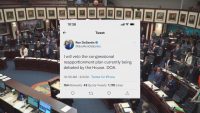
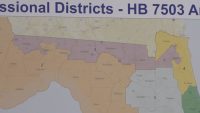
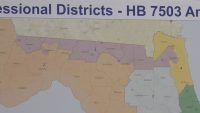
The Florida Legislature today sent two new congressional maps to the Governor, a primary map, and a backup incase the courts throw the first map out. But it may be for naught. During the debate in the House, Governor Ron DeSantis tweeted he would veto the maps. Democrat Leader Evan Jenne said its time for lawmakers to start over.
“I just wanted to read you a tweet” began Jenne. “I will veto the congressional apportionment plan currently being debated by the House. Period. DOA Period. That tweet came from out own Governor just moments ago. So as we do this is a product that is already been claimed as dead on arrival when it hits the Governor’s desk. Members, we need to seriously consider what we are doing with this bill.”
But the House passed the map legislation anyway. A short time later, the Senate approved the maps and send the bill to the Governor. Lawmakers could override the anticipated veto, but that seems unlikely for the GOP controlled legislature.
For the first time in 50 years, no one challenged the validity of newly draw House and Senate legislative districts, so today, the Supreme Court of Florida gave the maps a thumbs up, but as Mike Vasilinda tells us, lawmakers are still in a battle to redraw the Staes 28 Congressional districts.
The opinion from the Flordia Supreme Court says the fact no one filed a challenge against the newly draw House and Senate district maps put it in an unusual posture. The court also said its the first time in 50 years that no one filed a challenge. The House was in session when the opinion was released.
“It is my pleasure to announce to you the Florida Supreme Court has just issued their opinion upholding the constitutionality of our legislative maps” said Speaker Chris Sprowls minutes after the decision was released. “They are now the law in the state of Florida.”
Michelle Salzman was on the committee that drew the maps.
“”I super excited” she told us. “I was actually doing a little happy dance on the floor and just applauding. I’m so excited. You know we put a lot of work and effort into those maps and took very seriously the process., trying to make sure it was fair and equitable.”
A statement from House Democrat Leader Evan Jenne says the victory lap may be premature. He expects future challenges. For now, Cecile Scoon, the President the League of Women Voters Florida is still deciding.
“We’re going to make up our minds when we get to the very end of the precess” Scoon told us via Zoom from her home in Panama City.
Today’s ruling came when the Florida House of Representatives was discussing newly
Drawn congressional maps. Expect a challenge there for certain.
“This primary map does not comport with the standards. It’s unconstitutional” said Rep. Joe Geller (D-Miami) during debate.
A Jacksonville to Tallahassee Congressional map was threatened with a veto from the Governor
”And that is going to be the position we stick to, so, just take it to the bank” said Ron DeSantis on February 18th.
The House is actually passing two maps. The first to please the Governor. The second is a backup incase the first map falls.”




 No Comments »